
How accurate are DNA matches? Most DNA tests boast over 99% marker accuracy, but interpreting results depends on factors like shared DNA segments, database size, and testing methods. Larger DNA segments (over 15 cM) are highly reliable, while smaller ones (under 10 cM) can have false match rates of up to 85%.
What impacts match accuracy?
- Segment Size: Bigger segments mean better reliability.
- Database Size: Larger databases improve match chances.
- Endogamy: Shared DNA in endogamous populations can inflate match counts.
How to verify matches? Use tools like triangulation, segment analysis, and family tree integration to confirm relationships. Platforms like GEDmatch help compare results across testing companies for better accuracy.
Key Shared DNA Ranges:
| Relationship | Shared DNA (cM) | Confidence Level |
|---|---|---|
| Parent-Child | ~3,400 | Extremely High |
| First Cousin | ~850 | High |
| Fourth Cousin | 20–85 | Moderate |
To ensure accuracy, combine DNA results with traditional genealogy research and tools like chromosome browsers or family tree data.
DNA Match Accuracy Basics
DNA Match Process
DNA matching focuses on the 0.1% of our genetic code that varies between people. MyHeritage analyzes around 700,000 SNPs (single nucleotide polymorphisms) to find relatives. The system compares DNA segments in its database, and when identical segments are detected, it measures their length in centimorgans (cM) to estimate relationships. Here’s a quick look at typical shared DNA amounts for different relationships:
| Relationship | Shared DNA (cM) |
|---|---|
| Parent-Child | 3,400 |
| Full Siblings | 2,550 |
| Half-Siblings | 1,700 |
| First Cousins | 850 |
"DNA Matching is the process of sequencing your DNA and comparing it to the DNA of other people in a database. When a person with a significant amount of DNA that is identical to yours is found, that can indicate that you have a common ancestor." – MyHeritage Knowledge Base
Match Accuracy Factors
Several factors impact the accuracy of DNA matches:
- Database Size: The bigger the database, the better the chances of finding relatives.
- Segment Size: Larger shared DNA segments (especially those over 15 cM) are more reliable for determining relationships.
- Testing Method Quality: Modern genotyping arrays are extremely precise, with an error rate of about 0.1%.
These factors highlight both the strengths and the limitations of autosomal DNA testing.
Known Match Limits
Autosomal DNA testing is most reliable for tracing relationships up to five or six generations back. Beyond that, shared DNA becomes too diluted to draw clear conclusions. Algorithms can also struggle with populations that are genetically similar, leading companies to provide relationship ranges instead of exact matches.
Differences in reference populations can further complicate match accuracy, especially for those from regions with less representation in databases. To get the best results, genetic genealogy often combines DNA testing with traditional family tree research.
Why False Matches Happen
Endogamy Effects
Endogamy – marrying within a specific group over many generations – can significantly increase reported shared DNA, making relationship predictions more challenging. People from endogamous populations often have inflated match counts compared to the usual 30,000 matches. For example, a study on Easter Island revealed that between 1937 and 1965, 96.5% of births came from endogamous marriages, demonstrating how geographic isolation can intensify this effect.
"Prolonged endogamy in particular leads to elevated DNA sharing among descendants of a much larger group that may not be very closely related in real time."
This situation makes it essential to distinguish between Identical by Descent (IBD) and Identical by State (IBS) matches.
IBS vs. IBD Matches
The size of a DNA segment plays a critical role in determining match accuracy:
| Segment Size (cM) | Probability of a True IBD Match | Reliability |
|---|---|---|
| Under 6 cM | ~1% | Very Low |
| 6–16 cM | 15–50% | Moderate |
| Over 45 cM | 99%+ | Very High |
One Family Tree DNA customer conducted a study using manually phased data from 14 relatives. It showed that 85% of segments under 5 cM were false matches. These technical details highlight why testing companies refine their methods to address such challenges.
Testing Company Match Rules
To improve match accuracy, DNA testing companies use specific thresholds and algorithms to manage these complexities.
"The algorithm says, ‘Let’s try to put ancestors together in different combinations, to get a similar variation [of SNPs] that you have.’" – Yaniv Erlich, MyHeritage
In endogamous populations, a 30 cM match may appear as multiple smaller segments, whereas in non-endogamous groups, it typically appears as a single segment. Testing companies are increasingly prioritizing the size of individual segments, as segments over 45 cM almost always indicate genuine relationships.
Checking Match Accuracy
DNA Triangulation Methods
DNA triangulation helps confirm genetic connections by comparing shared DNA segments across three individuals. Think of it as forming a triangle: you (Point A), a close match (Point B), and a shared match (Point C). This setup helps verify relationships through overlapping DNA segments.
Here’s how you can use triangulation effectively:
- Pinpoint your "Best Match" with a known genealogical link.
- Use shared match tools to identify potential Point C matches.
- Analyze DNA segments in chromosome browsers.
- Look for overlapping segments that confirm the relationship.
"Triangulation is a strategy genealogists can use to determine how genetic matches are related." – Diahan Southard
For instance, Edward used triangulation among cousins to confirm his maternal grandfather’s identity. A second cousin match, verified through shared DNA, provided the link he needed.
This method works best when paired with other techniques, like integrating family tree data, as detailed below.
Match Groups and Family Trees
Combining genetic data with family tree research makes DNA matches easier to interpret. Shared DNA is measured in centimorgans (cM), which helps estimate relationship distances and directs your research.
| Relationship Level | Action Steps | Verification Method |
|---|---|---|
| Close Matches | Review immediate family trees | Compare direct ancestors |
| Distant Matches | Build simple family trees | Look for surname patterns |
| Unknown Matches | Check shared matches | Identify family sides |
By grouping matches, you can organize your research and confirm relationships more accurately.
DNA and Paper Trail Research
Pairing genetic data with historical records strengthens match verification. This approach not only confirms documented family ties but also uncovers hidden connections in your genealogy.
An example comes from Diahan Southard’s work on her third great-grandfather, Richmond Claunch. By combining AncestryDNA results with historical records, she discovered new matches with the Claunch surname. Examining these matches’ family trees helped confirm Richmond’s parentage.
Using these methods together provides a thorough way to confirm DNA match accuracy.
sbb-itb-65d4ad3
DNA Match Analysis Tools
GEDmatch: Cross-Platform DNA Analysis
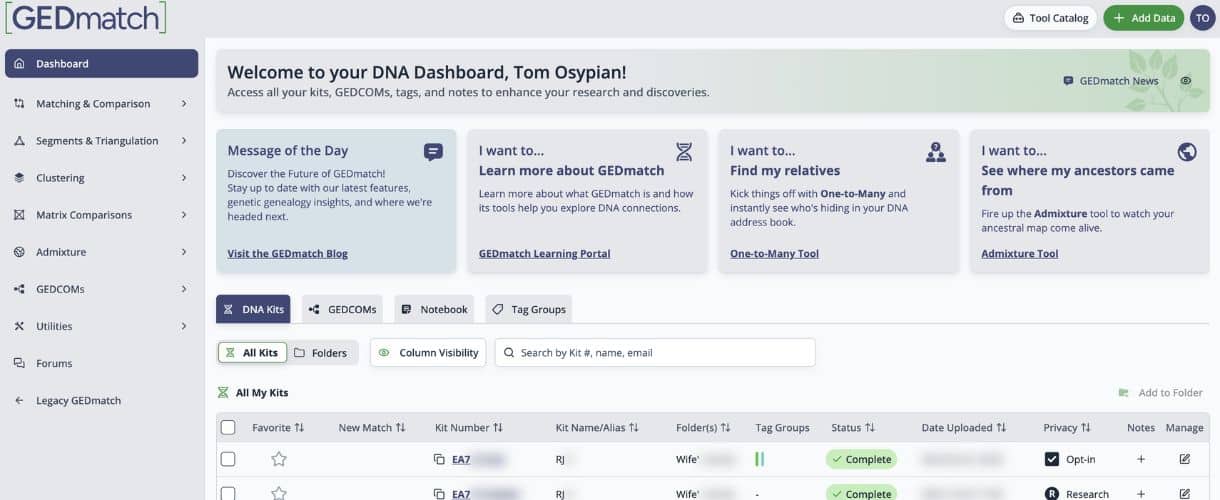
GEDmatch is a free platform that allows users to compare DNA results from different testing companies. With a database of over 2 million DNA profiles and family tree data from more than 400 million individuals, it offers extensive tools for finding and analyzing matches.
Here’s a quick look at some of GEDmatch’s key features:
| Tool | Purpose | What It Does |
|---|---|---|
| One-to-Many Comparison | Finds matches across multiple testing services | Expands your pool of potential matches |
| One-to-One Autosomal | Confirms shared DNA amounts | Helps verify relationships |
| Admixture Analysis | Identifies biogeographical ancestry | Provides insights into heritage |
| Segment Search | Tracks shared DNA segments | Helps validate matches |
"GEDmatch offers a free DNA site built for genetic genealogy research. With a global database of autosomal DNA data and unmatched utility, we make this data accessible and effective." – GEDmatch
In addition to basic match comparisons, GEDmatch provides advanced tools for analyzing DNA segments in greater detail.
DNA Segment Tools
Chromosome browsers and segment analysis tools allow users to dive deeper into genetic connections. With GEDmatch, you can:
- Compare specific DNA regions across matches.
- Identify overlapping segments shared by multiple individuals.
- Map shared DNA patterns across family lines.
- Validate potential relationships by examining segment size.
These tools are especially useful for analyzing distant matches or unraveling complex family relationships. They work hand-in-hand with comparisons from multiple tests to refine and confirm genetic connections.
"I love being able to examine matches across various testing company platforms. I also have found the auto clustering very, very helpful." – Cathy, GEDmatch User
Using Multiple DNA Tests
Testing with multiple companies can increase your chances of finding matches and improve the accuracy of your results. By downloading raw DNA data files from different services and uploading them to GEDmatch, you can utilize its specialized tools to compare results across platforms.
Here’s how it works: Download your raw DNA data, upload it to GEDmatch, and use the platform’s tools to analyze matches from various testing companies. This approach not only broadens your match pool but also improves the reliability of your findings.
For instance, a GEDmatch user named David successfully located his siblings by combining results from multiple testing companies. Since each company uses its own algorithms and databases, GEDmatch provides a more complete view of genetic connections by consolidating data from different sources.
DNA Match Confidence Levels
Understanding centiMorgans
CentiMorgans (cM) are used to measure the shared genetic segments identified in DNA testing. To put it simply, one centiMorgan represents about 1 million base pairs in human DNA.
Shared cM Ranges and Confidence Levels
| Relationship | Shared cM Range | Confidence Level |
|---|---|---|
| Parent/Child | 3,475 cM | Extremely High |
| Full Siblings | 2,400–2,800 cM | Extremely High |
| Grandparent/Aunt/Uncle | 1,450–2,050 cM | Very High |
| First Cousin | 680–1,150 cM | High |
| Second Cousin | 200–620 cM | Good |
| Fourth Cousin | 20–85 cM | Moderate |
These ranges are key to understanding how DNA match scores are interpreted.
Reading Match Scores
DNA tests use shared cM to calculate confidence scores for potential relationships. These scores are determined by the amount of shared DNA and where those segments are located.
Here’s how confidence levels align with shared DNA:
- Extremely High (60+ cM): Almost 100% certainty
- Very High (45–60 cM): Roughly 99% confidence
- High (30–45 cM): Around 95% confidence
- Good (16–30 cM): Greater than 50% confidence
- Moderate (6–16 cM): 15–50% confidence
Strong vs. Weak Matches
After determining match scores, the next step is evaluating the strength of these matches. This involves looking at both the total shared cM and how continuous the DNA segments are. For example, AncestryDNA’s 2020 algorithm update excluded matches with less than 8 cM to minimize false positives.
What Defines a Strong Match?
- High-confidence segments consistently appearing across multiple genome regions
- Large, continuous DNA segments instead of smaller, scattered ones
- Matches verified on multiple testing platforms
- Clear alignment with expected relationship ranges
Signs of a Weak Match
- DNA segments below 8 cM
- Fragmented patterns without continuity
- Matches found on just one testing platform
- Similarities that might stem from shared population traits rather than direct relationships
As Ann Turner explains:
"I think of the cM as being a unit of ‘effective’ distance… We’re more interested in the probability that a segment will be passed on intact than the size of the segment in Mb."
This highlights the importance of focusing on segment integrity and probability when assessing DNA matches.
Are Ancestry DNA Results Accurate?

Conclusion
Achieving accurate DNA match results requires blending genetic evidence with traditional genealogy techniques. A case study by Legacy Tree Genealogists on Frank M. Stanley highlights how DNA matches can help resolve conflicting historical records.
Key Tools and Methods for Validating Matches:
- GEDmatch: Enables cross-platform analysis to confirm DNA matches.
- DNA Painter: Offers chromosome mapping for visualizing patterns.
- Match Clustering: Groups matches by family branches for deeper insights.
These tools demonstrate how combining modern technology with historical records improves the accuracy of genealogical research.
"At Legacy Tree Genealogists, we understand that, as powerful as DNA can be in identifying ancestors, it is only effective when combined with traditional document research."
To strengthen genealogical conclusions, it’s crucial to align different types of evidence, such as:
- DNA segment data
- Historical documents
- Family tree connections
- Geographic links
- Surname trends